100 Days at Sea Companions — All 7, With the Real Rates
Companions are Pearl-chest rolls, and the good ones are rare. Here's every verified companion, what it actually does, and how to think about the odds before you spend.
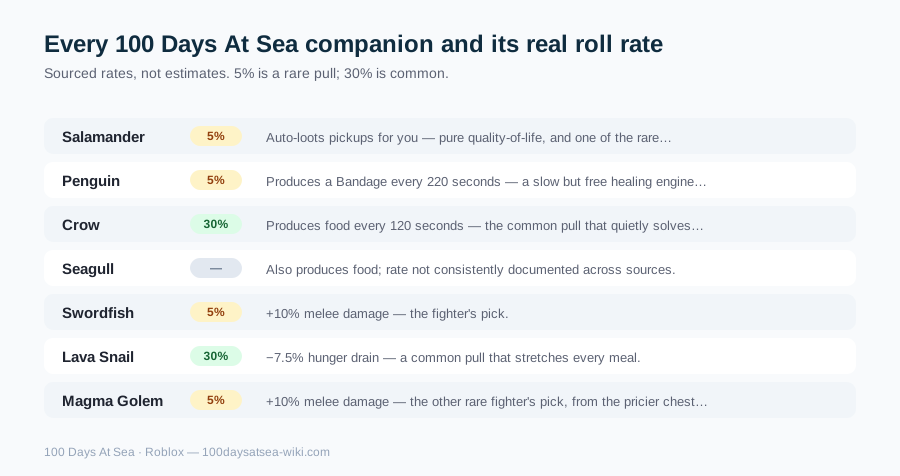
The full 100 Days at Sea companions roster
| Companion | Roll rate | What it does |
|---|---|---|
| Salamander | 5% | Auto-loots pickups for you — pure quality-of-life, and one of the rare pulls. |
| Penguin | 5% | Produces a Bandage every 220 seconds — a slow but free healing engine, great for solo runs. |
| Crow | 30% | Produces food every 120 seconds — the common pull that quietly solves early hunger. |
| Seagull | — | Also produces food; rate not consistently documented across sources. |
| Swordfish | 5% | +10% melee damage — the fighter's pick. |
| Lava Snail | 30% | −7.5% hunger drain — a common pull that stretches every meal. |
| Magma Golem | 5% | +10% melee damage — the other rare fighter's pick, from the pricier chest pool. |
Chests are bought with Pearls; the Magma and Pirate chests are the only ones whose price is published — 120 Pearls each.
How companion chests actually work
Companions are not bought directly. You buy chests from the Companion Shop, and each chest carries a drop chance for a companion based on its rarity tier — higher-rarity chests give better odds at the stronger companions (Pro Game Guides' beginner guide, re-fetched July 26, 2026). That is the mechanic behind the two rate tiers in the table above: the 5% names are what the good chests are gambling you toward.
Worth separating from all of this: the chests you open duringa run are a different system entirely. The game's own badge list tracks those separately — one badge for opening 100 chests in a single run, another for 500 across your account, another simply for pulling a gun out of one. Those drop loot and weapons, not companions. Companion chests cost Pearls in the lobby; the Magma and Pirate chests are the only ones with a documented price, at 120 Pearls each.
What a 5% roll rate actually means
A 5% rate does not mean twenty chests gets you the companion. It means each chest is an independent coin-flip with heavily loaded odds, so the honest way to read it is as a probability curve. Here is the chance of seeing a specific companion at least once, straight arithmetic on the documented rates:
| Chests opened | A 5% companion | A 30% companion |
|---|---|---|
| 1 | 5% | 30% |
| 5 | 23% | 83% |
| 10 | 40% | 97% |
| 20 | 64% | 99.9% |
| 45 | 90% | — |
Read the 20-chest row twice. Twenty rolls is the average wait for a 5% pull, and it still leaves you a one-in-three chance of walking away empty. Price that at the only chest cost anyone has published — 120 Pearls for the Magma and Pirate chests — and twenty rolls is 2,400 Pearls, more than three 750-Pearl classes. Cheaper chests exist and their prices aren't documented, so treat that as the ceiling rather than the going rate. The 30% column is the other lesson: five chests make a common companion near-certain, which is why Crow and Lava Snail are the companions you should plan around.
Penguin vs Crow: what the timers are worth
The two generator companions are usually compared by rarity, which is the wrong axis — they produce different things at different speeds. PGG lists Crow and Seagull together as food every 120 seconds, and the Penguin at a Bandage every 220. Turned into output:
| Companion | Interval | Per 10 min | Per hour |
|---|---|---|---|
| Crow / Seagull | 120s food | 5 food | 30 food |
| Penguin | 220s Bandage | ~2.7 Bandages | ~16 Bandages |
The Crow ticks 1.8× faster, but the comparison that matters is what each one replaces. Food you can already build: a Crab Trapis a passive food supply and PGG's tested build order puts it second, right after the Sawmill. No structure anyone has documented produces Bandages. On the evidence we have, then, the Penguin is the only companion making something your raft cannot — and the Crow a convenience that duplicates a structure you should be building anyway.
One caution before you count on the Penguin as a safety net: a Bandage is not a Medkit. Player footage settles that Medkits are the item used to revive a downed teammate, with bandages used for topping yourself up. A Penguin keeps you healthy between fights; it does not get anyone off the floor.
The two melee companions, and the class that doubles them
Swordfish and Magma Golem have the same documented effect (+10% melee damage) at the same documented rate (5%), which means there is no choosing between them — you take whichever chest pool you were buying anyway, and only the Magma Golem's pricier pool is documented. Nobody has published whether owning both stacks.
There is a subtler trap here. PGG's class sheets treat magic damage and melee damageas separate stats — Fire Mage's Magma Staff and Ice Mage's Ice Staff scale with magic, while Knight's Claymore and Hero's Holy Sword scale with melee. Whether a +10% melee companion does anything at all for a staff class is unstated by every source we have. If you are saving toward a mage, that is worth knowing before you spend Pearls on a fighter companion.
The one class built around this page is Zookeeper (300 Pearls), which increases companion buffs by 100% and adds a further 25% at each of levels 2, 3 and 4. PGG rates it mid-tier for a blunt reason: it multiplies companions you may not have, and getting good ones is exactly the 5% problem described above. It is the last purchase in a companion plan, not the first — see the full class price ladder.
How to think about the odds
Every strong companion (Salamander, Penguin, Swordfish, Magma Golem) sits at a 5% rate — expect roughly one in twenty rolls, which means chasing a specific rare is expensive. The 30% tier (Crow, Lava Snail) is where chests reliably pay: food generation and hunger reduction are unglamorous but they compound over a 100-day run. Fund your class plan first; roll chests with the surplus.
What still isn't documented
- The Seagull's roll rate. Its effect is now documented — PGG pairs it with the Crow at food every 120 seconds — but no source gives a drop chance.
- Chest prices below 120 Pearls, and which chest holds which companion. Only the Magma and Pirate chests have a published price, and the pools are described by rarity rather than by contents.
- Whether duplicates or multiple companions stack. No source addresses it.
- A "Pirate Gunner" companion. PGG's tier list names one in passing as a good companion for Zookeeper players. It appears in no rate list we have seen, and we are not going to invent an effect for it — but if it is real, this roster is short a name.
- Any link between the Penguin companion and the Ice Biome. The badge list includes one for rescuing all the penguins in the Ice Biome. Whether that has anything to do with the companion, no source says — and we are not joining those dots for you.
FAQ
What is the best companion in 100 Days At Sea?
Depends on your run. Solo survival: Penguin (a free Bandage every 220s is sustained healing nobody else provides). Fighters: Swordfish or Magma Golem (+10% melee each). Easiest real value: Crow — at a 30% roll rate, its food every 120s is the companion you'll actually get.
How do I get companions?
Buy companion chests with Pearls and roll the odds — the strong companions sit at 5% rates, the common ones at 30%. The Magma and Pirate chests are the only ones with a published price — 120 Pearls.
Are companion drop rates confirmed?
The rates listed here (5% / 30%) are cross-referenced from Pro Game Guides' and Deltia's Gaming's companion coverage — two independent hands-on sources. Seagull's rate is the one gap: sources list the companion but not a consistent number.
Should I spend Pearls on companions or classes?
Classes first, for most players — a class is a guaranteed permanent kit, while chests are RNG. Companions are the luxury purchase once your class plan (usually toward Fire Mage) is funded.